
Alexandru Angheluș, CEO of Prodefence and President of CYSCOE, has released version 1.2.0 of the HumanAI and OrgAI Framework Calculator, a free tool that helps organisations assess the capacity they actually build when people work with artificial intelligence.
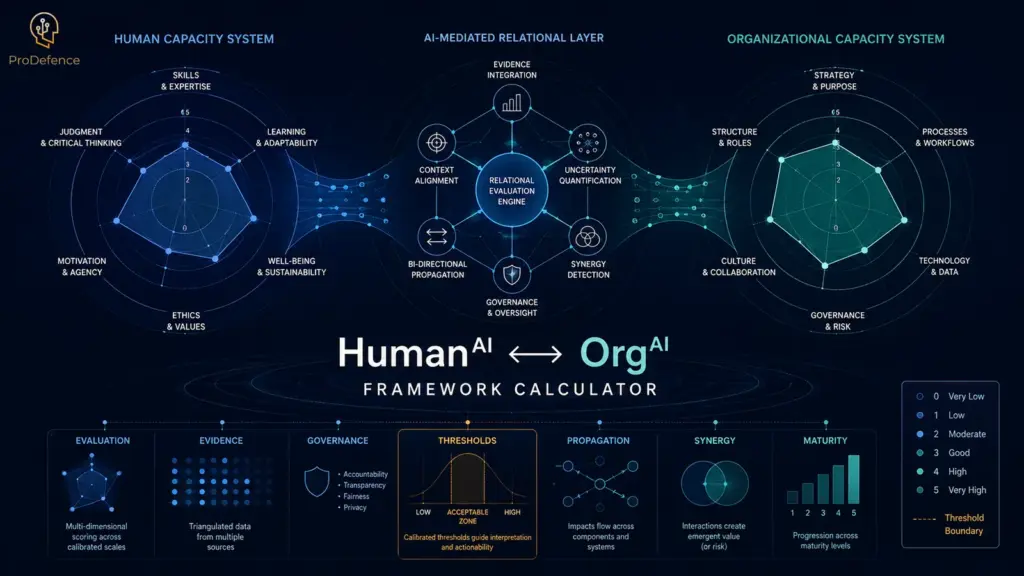
The calculator turns the conceptual framework from the paper “HumanAI and OrgAI: A Relational Framework for AI-Mediated Human and Organizational Capacity” into a practical assessment sheet. Instead of asking whether an organisation “uses AI”, it asks what has really changed: in the people, in the organisation and in the way errors and decisions travel between them.
Built for sensitive environments
The calculator is a single HTML file that runs entirely in the browser. It needs no installation, no account and no network connection, so it can be used on isolated networks.
- no network requests: a strict Content Security Policy blocks all outgoing connections;
- no cookies, no local storage and no analytics;
- checked by 29 automated tests;
- results shown on screen, as a printable assessment sheet of about 17 pages, or as a JSON file that can be imported again.
What it assesses
- Classification – a ten-question membership test;
- Epistemic decoupling – the gap between access to AI and human validation, with confidence intervals;
- Propagation exposure – how errors are amplified when AI outputs are reused;
- OrgAI threshold – six constitutive organisational conditions;
- Contribution profile – impact across seven dimensions;
- Synergy test – performance against relevant comparators;
- Maturity levels – M0 to M5, per domain;
- OrgAI profile – organisational outcomes across nine dimensions.
An anti-pattern detector also flags contradictions between the answers given in different modules.
A profile, not a score
The calculator deliberately does not produce a single composite score. It shows a profile across dimensions, with the direction and size of each change. Confidence intervals are calculated from the number of tasks, so a result that is not supported by enough work is reported as “undemonstrated at this task volume”. Every organisational condition needs a reference to evidence; conditions without one are shown as “declared, undocumented” and do not count towards the threshold.
What is new in v1.2.0
Version 1.2.0 aligns the calculator with its whitepaper. Material contribution is now assessed across seven dimensions, exported reports include the seven fields of the minimum reporting convention, access and validation are measured as shares of tasks, and validated learning is linked back to the organisational architecture. The release also adds the classification sheet, evidence references, a before/after exposure comparison, the nine-dimension organisational profile, maturity levels per domain, the anti-pattern detector and a reimportable JSON schema.
Limits, stated openly
The results are interpretive. They are not empirical validation, certification or a legal assessment, and the values remain the assessor’s statements until they are backed by evidence. The calculator must not be the sole basis for decisions with significant consequences, a warning that stays visible in the interface at all times.
Download and licence
- Calculator (source code and ready-to-use index.html): DOI 10.5281/zenodo.22884721
- Framework paper: DOI 10.5281/zenodo.22295278
- Code under the MIT licence © 2026 S.C. PRODEFENCE S.R.L.; the conceptual framework under CC BY-ND 4.0. Please cite both works when you rely on the framework.
For a walkthrough, see the guided tour and the original announcement on prodefence.ro.
#CYSCOE #HumanAI #OrgAI #AIGovernance #OpenSource #Cybersecurity

